
Blog · Compliance
EPCs, ESG Disclosures and Verifiable Data: Why One Dataset Has to Serve All Three
Mandatory sustainability disclosures, Energy Performance Certificate (EPC) compliance and carbon reporting are usually treated as three separate jobs, owned by three separate teams. In practice they rest on the same foundation: the energy, floor area and emissions data of the buildings you own and occupy. The question regulators, auditors and investors are now asking is not just whether you report, but whether the numbers can be verified.
Three obligations, one dataset
Consider what each obligation asks for.
- EPC compliance. Under the National Energy Act regulations, qualifying buildings need a valid, registered and displayed EPC. A SANEDI-registered EPC Professional cannot issue a defensible rating without twelve months of metered energy consumption and a verified net floor area. With the DEE’s enforcement framework now active, gaps in that data translate directly into non-compliance notices.
- ESG and sustainability disclosures. South Africa is moving towards mandatory, standards-based sustainability reporting aligned with the ISSB’s IFRS S1 and S2, with listed companies and their property portfolios expected to feel the shift as early as 2027. Climate-related disclosures demand energy intensity, Scope 1 and 2 emissions and transition risk, all reported with the same rigour as financial statements.
- Carbon disclosure. Carbon tax liability, the Climate Change Act’s reporting obligations and frameworks such as GRESB and CDP all start from the same activity data: kilowatt-hours consumed, fuel burned and the floor area it serves.
The overlap is obvious once it is laid out. The kWh/m²/a figure that drives an EPC grade is the same intensity metric an investor will look for in a climate disclosure, and the same consumption data that feeds a carbon calculation. Collect it once, collect it properly, and it serves all three.
Why verifiable data is the real test
Most organisations already have some version of this data. The problem is that it lives in utility invoices, tenant recovery spreadsheets, municipal rates records and building plans that have not been reconciled with each other. Figures assembled under deadline pressure are hard to defend when an inspector, assurance provider or fund manager asks where they came from.
Verifiable data has three qualities: it is traceable to a source (a meter, an invoice, a measured plan), it is consistent across every report it appears in, and it is complete for the full reporting period. An EPC built on estimated floor areas, or a climate disclosure that uses different consumption figures from the carbon tax return, is exactly the kind of inconsistency that assurance processes are designed to catch.
“The gap is rarely a lack of data. It is the gap between the data you have and the data you can stand behind.”
The first step: a free EPC Pre-Assessment
To help close that gap quickly, GreenBDG Africa recently launched its free EPC Pre-Assessment tool. Enter your building’s classification, climatic zone, net floor area and annual energy use (grid electricity, diesel and solar PV), and it returns an indicative EPC grade from A to G in seconds, benchmarked against the SANS 10400-XA reference values and placed on the SANS 1544 energy performance scale.
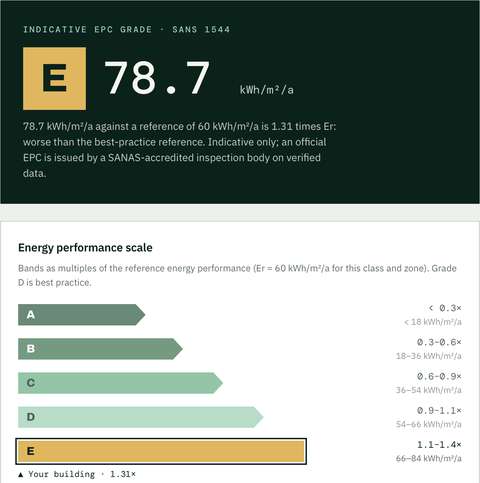
The result is indicative, not a certificate; an official EPC is still issued by a SANEDI-registered EPC Professional on verified data. But the exercise itself is the point. To use the tool you have to find your twelve months of consumption and confirm your floor area, which is precisely the data you will need for:
- the formal EPC assessment and NBEPR registration;
- energy intensity and Scope 2 figures in your ESG and climate disclosures;
- carbon tax and GHG reporting calculations.
It also tells you early where you stand. A building that lands at grade E or below is a signal to look at efficiency measures and Section 12L opportunities before the rating becomes public, not after.
From pre-assessment to disclosure-ready
With ESG disclosures set to become prominent in South Africa from 2027, the organisations that move first will be the ones that treat EPC compliance as the start of a single, verifiable data pipeline rather than a once-off certificate. Run the pre-assessment across your portfolio, identify where metering or floor area records are missing, and fix those gaps once.
How GreenBDG can help
- Free indicative EPC grades with the EPC Pre-Assessment tool
- EPC compliance: data collation, registered assessment, NBEPR registration and SANEDI submission
- Automated energy and carbon monitoring on the GreenBDG platform
- ESG reporting aligned with IFRS S1/S2, GRESB, CDP and the GHG Protocol